Courtship as warfare
The Life and Opinions of Tristram Shandy, GentlemanCourtship as warfare is the novel’s governing conceit for Widow Wadman’s advances toward Uncle Toby. Their neighboring gardens, a wicker gate, and Uncle Toby’s sentry-box turn a courtship into a campaign: she studies his habits and military preoccupations, while he reads the encounters as occasions to explain maps and fortifications. The metaphor makes desire a contest of positions and approaches, but its central irony is that the two participants do not understand the same action in the same way.
Space and the Conditions of Approach
The campaign is made possible by the arrangement of the houses and gardens. The Fates, the narrator says, have joined Widow Wadman’s property to Uncle Toby’s, with a thick hedge-row arbour on her side and a vantage point from which she can observe his movements and hear his plans. The physical setting gives her both intelligence and access: she can follow the military operations in his mind while planning approaches in the garden beside him.
A wicker gate intensifies that proximity. Uncle Toby has permitted Corporal Trim, through Bridget’s mediation, to make it as a means of enlarging Widow Wadman’s walks. The considerate provision becomes a passage for courtship: it brings her to the very door of the sentry-box, where she can launch what the narrator describes as attacks, sometimes attempting to blow Uncle Toby up within his own post. The setting is not simply a backdrop to the metaphor; a gate, hedge, arbour, and sentry-box supply its actual routes, cover, and objective.
The Map as a Courtship Instrument
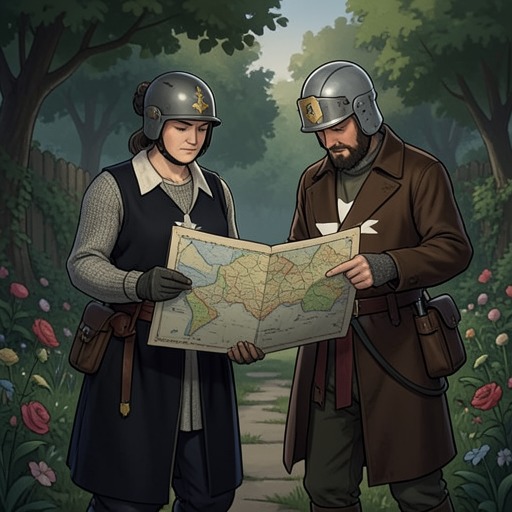
Uncle Toby’s habit of keeping a plan of whichever town or fortress Trim is working on provides Widow Wadman with a ready-made pretext. The map is pinned inside the sentry-box on the left, loose at the bottom so that it can be lifted for inspection. Once Widow Wadman reaches the entrance, she can take hold of one corner and bring the plan forward. Uncle Toby, absorbed at once, takes the other corner and begins to explain it. A military consultation thus becomes the opening movement of an intimate encounter, although he understands it as a discussion of fortifications.
The narrator elaborates the approach as a sequence of tactical advances. Widow Wadman takes Uncle Toby’s tobacco-pipe, ostensibly to point more clearly at a redoubt or breastwork. This forces him to use his forefinger instead. Unlike the inert end of the pipe, his finger can be touched; following it along the turns and indentations of the miniature works gives her a means of making contact. The map’s lines become a route across which the flirtation proceeds, and its military vocabulary provides cover for gestures that would otherwise announce their purpose.
When the map falls against the side of the sentry-box, Uncle Toby lays a hand flat upon it to continue his explanation. Widow Wadman places her hand beside his, opening what the narrator calls a passage for sentiment. Her finger follows his; the contact draws the thumb and then the whole hand into play. The comic precision of the description—each touch, pressure, and displacement recorded like a movement in a campaign—shows how bodily closeness is achieved by stages, under the guise of studying a plan.
The military image extends to the participants’ whole positions. While Widow Wadman presses her leg against Uncle Toby’s calf beneath the sentry-box, he is described as attacked on both wings and thrown into disorder at his centre. His exclamation, “The duce take it!”, breaks through the strategic narration, but the scene does not make him a conscious partner in her design. The humor rests on the contrast between the narrator’s elaborate account of an assault and Uncle Toby’s guileless attention to the business of explaining his works.
Plans, Improvisation, and Interrupted Assaults
The metaphor also makes room for failure. After Corporal Trim has finished recounting his love affair—related by Uncle Toby on Trim’s behalf—Widow Wadman leaves the arbour, adjusts the pin in her cap, passes through the wicker gate, and advances toward the sentry-box. The narrator presents this as a favorable moment, and the ground has been cleared: Uncle Toby has ordered away the pioneer’s shovel, spade, pickaxe, pickets, and other stores scattered where Dunkirk stood.
Yet a plan cannot master every circumstance. The map now hanging in the sentry-box is the plan of Dunkirk, and the tale of Dunkirk has left the moment relaxed rather than responsive to Widow Wadman’s intended attack. Moreover, the delicate maneuvers of fingers and hands have just been outdone by those in Trim’s tale of the Beguine. What had previously worked has, in the altered circumstances, become a peculiarly ineffective approach. Widow Wadman changes her attack as soon as she opens the gate. The episode makes the courtship metaphor flexible: desire may be strategized, but the results depend on timing, context, and competing stories.
That attention to context also gives the conceit a self-conscious edge. The narrator mocks the belief that a person can act successfully by plan alone, while imagining Widow Wadman’s sentry-box campaign as a plan worthy of being entered in gold in the archives of Gotham. The joke depends on the mismatch between the grand scale of military planning and the small, shifting circumstances of a flirtation. A fixed scheme can be defeated not by a fortress but by the wrong map, a change of mood, or a freshly told story.
Reciprocal Campaigns and Comic Performance
Courtship as warfare also organizes the parallel business of Uncle Toby and Trim. As Widow Wadman pursues Uncle Toby, Bridget expects Trim to make love to her; she allows him room to do so in order to discover what is happening. Meanwhile, Uncle Toby invites Trim to lay out a plan for the attack on Widow Wadman and gives him a crown to begin his commission. The language of military command turns the preparation for a proposal into an operation with an aide-de-camp, equipment, and assigned positions.
Trim’s plan is elaborate in its material details. He would have Uncle Toby’s laced clothes brought out of the campaign trunk, aired, and repaired at the sleeves; the white ramallie-wig would be freshly dressed, the razors reset, and the sword attended to. Trim proposes putting on his montero cap and the regimental coat of Lieutenant Le Fever, which Uncle Toby had given him to wear in Le Fever’s memory. When everything is ready, Uncle Toby will engage Widow Wadman in the right-hand parlour while Trim attacks Bridget in the kitchen to the left. He confidently predicts that, once the pass is seized, the day will be theirs.
Uncle Toby, however, admits that he would rather march to the edge of a trench than advance on a woman. Trim answers that a woman is quite a different thing. The exchange reveals the limit of the military metaphor: it gives Uncle Toby and Trim a vocabulary for organizing a proposal, but it cannot make courtship feel like warfare to Uncle Toby. His reluctance and Trim’s practical confidence preserve the contrast that governs the larger conceit—military expertise can furnish an elaborate structure for love, while the emotional encounter remains uncertain and unlike a siege.
Significance of the Conceit
By translating gestures into military maneuvers, the narrative lets physical intimacy emerge through a comic language of maps, lines, passages, wings, and attacks. That language gives Widow Wadman agency as an observer and strategist, while Uncle Toby’s innocence leaves him vulnerable to maneuvers he interprets through his military hobby. The same vocabulary lets the men prepare for a proposal without resolving its uncertainties: Trim can draw up a campaign, but Uncle Toby cannot make himself eager to cross the trench.
The conceit is therefore more than a decorative comparison. It shapes the scenes’ space and pacing, turning a neighborly gate and a map inside a sentry-box into instruments of approach; it also supplies the irony through which deliberate courtship and innocent military absorption coexist. Each plan promises control, yet the episodes repeatedly show that love does not obey plans as neatly as a drawn fortress obeys its lines.